A pre-start client letter covers three points: the scope boundary with a price for extending it, the terms of staged payment, and the dates and format for check-ins. Four lines, and most of the typical conflicts never happen.
An NDA covers confidentiality, not working terms — so I gather the agreements into one letter.
Conflict 1: scope creeps
You named a figure. The client says “OK.” A week later, a task shows up that wasn’t part of the deal.
The problem isn’t that the client wants more. The problem is that the boundary was never visible.
How this gets fixed in the letter:
Scope: [60,000–100,000 ₴] covers the Ukrainian market only. The EU, if you decide to add it, is a separate stage at roughly a third of this amount.
Not “that’s not included.” But “that costs this much.”
The difference: the first sounds like a refusal, the second like a price list.
Conflict 2: the price becomes “the rate forever”
The client pays for a project. The project ends. The client says: “Let’s carry on at the same rate.”
If you never separated “the price of the project” from “the rate for continuing” — they’re right. You never said these were different things.
How this gets fixed:
And for the future: this figure is the price of this project, not a rate for continuing. If you want to carry on after it’s finished, we’ll work that out separately.
One sentence. Before the start. Saying it after the finish is far harder.
Conflict 3: there are no rules — and it shows
When there’s no agreement about response times, the client writes whenever suits them:
- Adds “just one more small thing”
- Messages at 11pm
- Expects a reply within a minute
How this gets fixed:
Timeline: start [date], checkpoint in two weeks, finish in [X] weeks.
Contact: I reply on working days, within [X hours].
Software is paid by you, within $150–250 a month. All accounts and domains are yours, and the infrastructure stays with you after the project.
Specific dates, specific figures, a specific format. Not “about a month” — a number you can come back to.
The letter template — copy and send
This is the actual letter I send a client before the start. Adapt it to your project.
One more thing before we start. We’ve signed an NDA, but it’s about confidentiality and doesn’t cover working terms. So I’m putting everything we’ve agreed in our correspondence into one message, so we’re both looking at the same page.
Scope: [amount] covers [what exactly]. [Additional part], if you decide to add it, is a separate stage for [amount or estimate].
Payment: in [number] stages — [share]% for [first stage] and [share]% for the rest.
Timeline: start [date], checkpoint [date], finish [date].
Contact: I reply on working [days/hours], within [X hours].
Software is paid by you, within [amount] a month. All accounts and domains are yours, and the infrastructure stays with you after the project.
And for the future: this figure is the price of this project, not a rate for continuing.
Does this match how you see it? Just one “OK” is enough.
Why “just one ‘OK’ is enough” isn’t a small thing
A letter that says “please confirm” sets a high price on replying, and the client goes quiet.
“Just one ‘OK’ is enough” brings that price down to zero. The client replies, and the agreement is on record.
Four triggers — and four phrases
The letter isn’t a shield. It’s the start of a conversation. But once a conflict has already happened, there’s something to point back to.
Client adds a task outside the scope: “We agreed that [amount] covers [scope]. What you’re describing is a separate stage — I can quote it separately.”
Client wants to continue “on the same terms” after finishing: “We agreed that this figure was the price of this project. I’ll quote continuing separately — want me to send an estimate?”
Client asks for “just one quick thing”: “I can do that. It’s a separate task — [X] hours, [amount]. Want me to start on it?”
Client messages at 11pm marked “urgent”: “I’m available during working hours. I’ll see it in the morning and reply first thing.”
The point of the letter is to record the terms before there’s a reason to break them. If a client knowingly ignores what was agreed, that’s a different problem — not one the letter can fix.
When four lines aren’t enough
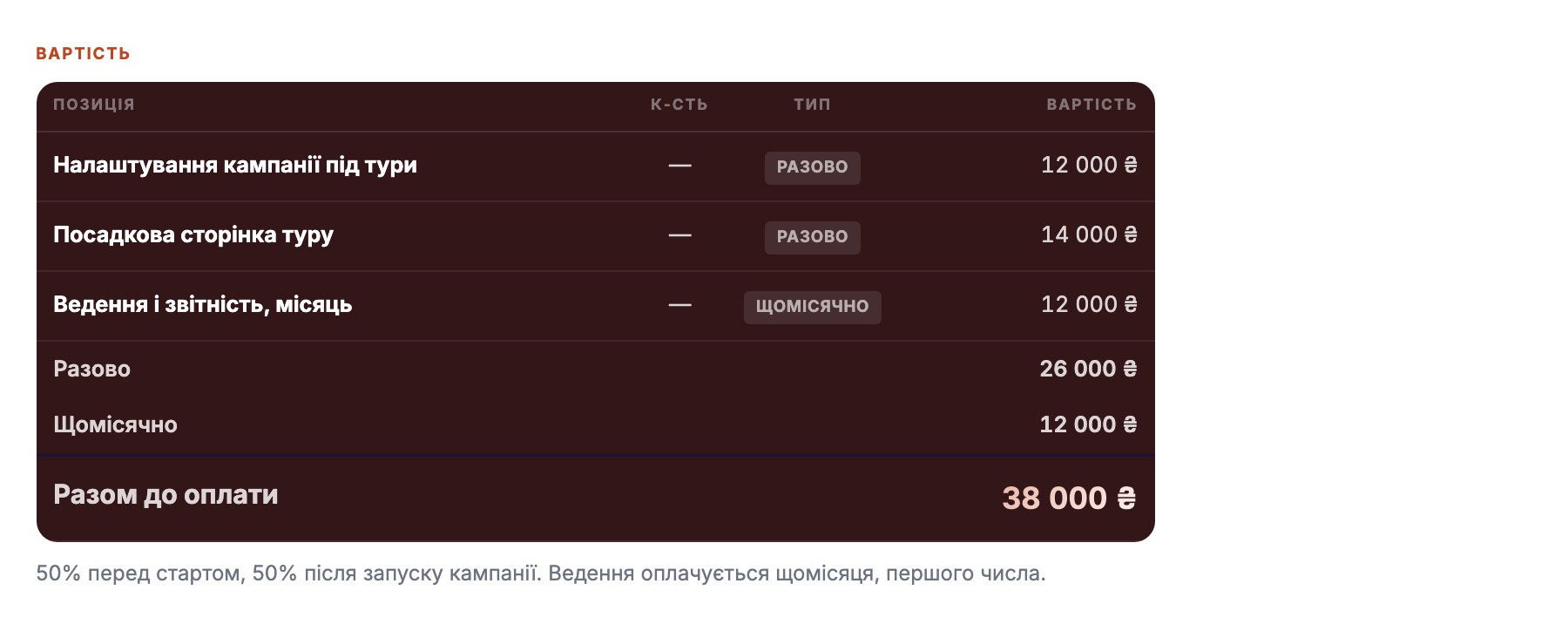
The letter works as long as the terms fit in a message. If there are several line items and each has its own price, the same thing needs to become a document — otherwise the client does the maths themselves, and gets it wrong.
For my own work, I put this into a proposal: line items with prices, a total for one-off and monthly amounts, payment terms in a single line under the table. The document comes out as a PDF, and there’s nothing left to agree verbally.
Where this agreement lives afterwards
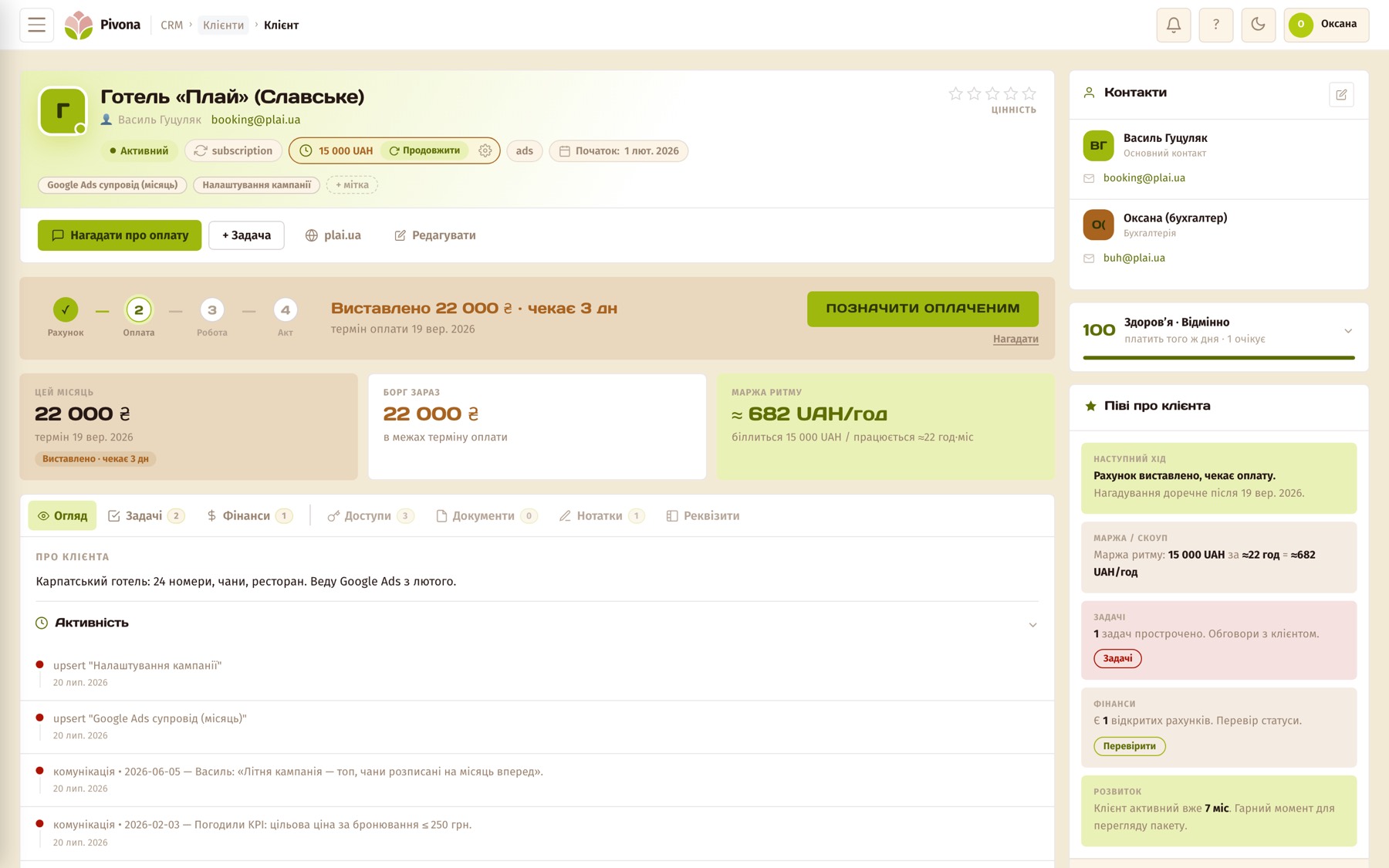
Once the project starts, the terms need to live somewhere, or in two months you’ll be searching for them in your message history — which is exactly where they get lost.
For me, they live on the client’s card: the agreed services, the monthly amount, the current debt, and a timeline of what was done and when. No system will write the letter for you — I’m building Pivona, and it doesn’t do that either. What it does is hold on to what you’ve already agreed, so there’s something to point back to.
The first 30 days in Pivona are free, no card required: pivona.io/pro-pivona.