After your first order on Freelancehunt or Kabanchik, three actions on day one — pinning down the agreement, getting contact outside the marketplace, and logging the client somewhere — decide whether they come back.
A first order is euphoria and fear at the same time. The five actions below deal with the fear.
Day one
1. Pin down the agreement in a single message
Not a contract. Not a three-page PDF. One message in the marketplace chat.
What it needs to cover:
- Scope — what’s included, and what isn’t. Any extension is a separate stage with a separate price.
- Payment — stages, amounts, mechanism (Escrow on Freelancehunt, upfront, or in instalments).
- Timeline — start date, checkpoint, finish.
- Software — who pays for the tools, and whose account they live on.
Separately, outside the list: “This amount is the price for this project, not the rate for continuing.” One sentence removes the most common conflict: the client remembers the first sum as a permanent rate.
Last line: “Does all this match what we agreed? One ‘ok’ is enough.”
A long message demanding formal confirmation often goes unanswered. A short “ok” lowers the cost of responding.
2. Get contact outside the marketplace
Telegram, email, phone — anything except the marketplace chat.
Commission. Lost notifications. A forgotten username. People remember a phone number. They don’t remember a marketplace handle.
Ask for the contact before the work starts, not after delivery. Once it’s delivered, there’s no motivation left to give it to you.
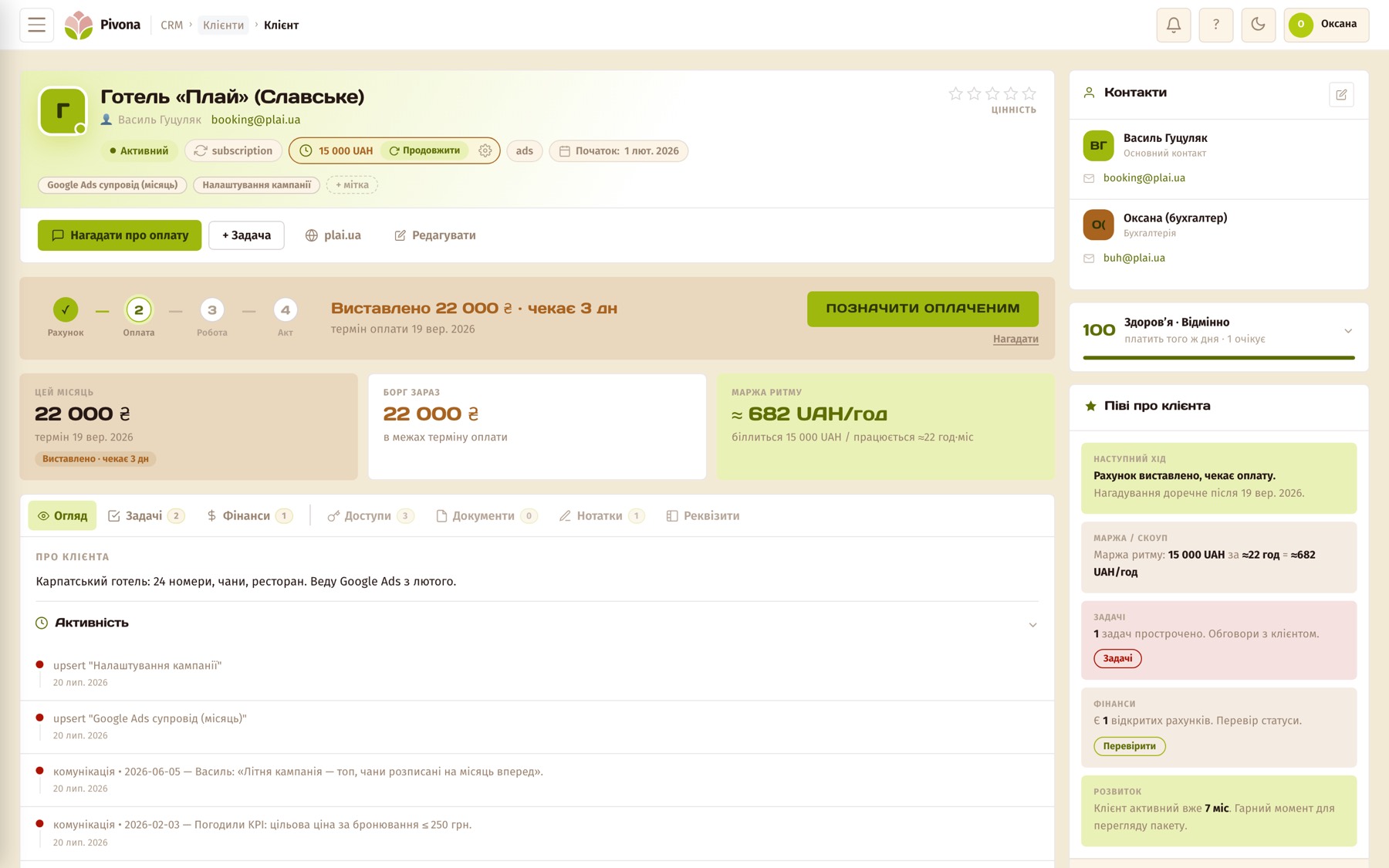
3. Log the client — anywhere, but log them
A spreadsheet, a note, a CRM — it doesn’t matter which. What matters is that a month from now you can find their name, their contact, and what you did for them.
Minimum: name, contact, what was done, how much was paid, date.
Out of 92 clients since 2020, the pattern I’ve noticed: the ones I logged came back. The ones I didn’t dissolved into old chats.
The first month
4. Write a week after delivery
Not with a pitch. With a question.
“Hi, is everything working? If anything needs fixing, I’m around.”
One sentence. It reminds them. It shows you care. It gives them a reason to reply.
Most freelancers deliver the work and disappear. One message a week later puts you in the minority that gets remembered.
5. Suggest the next step
Not “do you need anything else?” — that puts the work back on the client.
Instead, be specific: “I noticed that you have [observation]. I can do [action]. It’ll take [time] and cost [range].”
For example: I was setting up ads and noticed the site had no analytics — I wrote: “I can set up Google Analytics, it’s two days of work.” A prompt built on a real observation works. A generic “maybe you need something else” doesn’t.
Three mistakes after the first order
- Asking for a review on day one. The client hasn’t seen the result yet — the review will be formal, or there won’t be one at all.
- Offering a discount “for long-term cooperation”. A discount before the first result devalues the work: the client remembers not the quality, but the fact that you weren’t sure of your own price.
- Writing long messages. A marketplace client is used to short messages. They won’t read two screens of text.
What I record after action 3
Action 3 works in any format — I’m just showing you my own list of fields. For every client I record five things: name, contact, what was done, how much was paid, and when I last wrote to them, because that last one was exactly what I kept forgetting. Any spreadsheet with these fields will move anywhere later. Pivona, which I’m building, becomes useful once you have five clients: the first 30 days are free, no card required, at pivona.io/pro-pivona.
Agreements BEFORE the start — a separate topic
The five actions above come after you’ve won the job. What to write to the client before work begins, so you’re not untangling conflicts later, is covered in “A pre-start letter to the client: a template that prevents 3 conflicts.”