Twice in a month, marketplace clients said my texts looked AI-generated: a bid, and a chat reply that passed my AI-word counter. StoryScope research sees something similar in fiction: an algorithm spots AI by structure, even with clichés removed. Simplest check: picture another project with the same title. If your bid fits it too, it holds nothing for this client.
Two labels in one month
On August 10, I replied to a project about setting up tracking. The client wrote back that they didn’t understand what I was offering and that it looked like ChatGPT.
An AI wrote that text: Pivona, my product, writes my marketplace bids, and I also prepared the August 27 reply I describe below with an AI assistant. I sent both myself.
That same evening I built a counter for AI tells in Ukrainian text. It counts em dashes, “not this, but that” contrasts, three comma-separated words in a row, bookish words and back-to-back sentences of the same length.
On August 27, I replied to another client in a project chat. The counter showed zero em dashes, one “not this, but that” contrast and no runs of three. The next day the client politely turned me down over the price and wrote that it was all confusing and that I seemed to generate texts without checking them.
The bids and messages here were in Ukrainian or Russian. The quotes are translated; word counts are from the originals.
The study: in fiction, AI shows in the structure, even without clichés
In 2026, researchers from the University of Maryland and Google DeepMind published StoryScope. They took 10,272 short stories written by people and asked five models (Claude, GPT, Gemini, DeepSeek and Kimi) to write each one from the same premise.
The part closest to my counter was a separate test. They had Gemini remove clichés and purple prose from 278 of its own stories. It’s a similar move to asking ChatGPT to “make it sound more human.” The detection score (macro-F1) barely moved: 95.5% before the cleanup, 93.9% after. These were stories from one model only.
The study’s main classifier saw only structure: who makes the decisions, how time moves, how the story ends. It told AI stories from human ones with a score of 93.2% (macro-F1). An algorithm did the detecting. Whether people can tell them apart the same way, these numbers don’t say.
A caveat: these are English stories averaging about five thousand words. There are no bids among them. The authors state plainly that shorter texts can’t support these structural features, so the study carries neither its numbers nor its features over to a bid. What follows are my analogies: four signs I recognized in my own two texts. I’m leaving out the rest, such as emotion shown through the body or endings about acceptance, because they’re about plot, and a bid has no plot.
Four signs from fiction and what they resemble in a bid
1. The bid explains itself
In a bid this sounds like “results are what matter most to me” or “first I get to know your business.” In the stories, AI states the theme outright in 77% of texts, people in 52%.
My August 10 bid was built exactly like that: “I usually start by understanding…”, and at the end it promised “a clear picture.” The wording was recognizable too: three “not this, but that” contrasts in a short text. Which one gave it away, structure or words, I can’t separate.
Check: read the last sentence. If it’s about who you are and how you work, replace it with one thing from the client’s project.
2. A hint instead of a name
In a bid this is “experience with similar projects” or “I’ve worked with various platforms.” In the stories, AI names specific books and authors in 24% of cases versus 47% for people. This analogy is the loosest one: the researchers counted references to books and authors, and tool names don’t appear there, so all I take from it is the habit of naming specific things.
My August 10 bid had none: no tool, no breakage, no check.
Check: swap in another project with the same title. If the bid still fits, there’s nothing in it for this client.
Naming a breakage you can see in the client’s own description isn’t giving the work away: the paid part is fixing it. It’s different when the cause still has to be found in their account. Then the finding itself is work, and in the bid I only say what I’ll check.
3. A reply in topic blocks
In client messages, this reminds me of a reply that closes every question in its own block. In the stories, 79% of AI texts have no subplot at all, versus 57% for people. AI more often closes everything it opened.
My August 27 reply was like that: 162 words in blocks, “About the phrase,” “About the price” and “Now about Analytics,” almost three times longer than the client’s message. They had asked about a phrase from my bid and about the price, and I added the Analytics block myself. The client chose the word “confusing.” What they found confusing, the blocks or the price I gave as a floor with no ceiling, I don’t know: both were there.
From here on, it’s my conclusion, not the study’s. If the client asked about something, answer right away and briefly. What you wanted to add yourself can wait, and let it stay open.
4. A text with no one on the other end
In a bid this shows in two ways: there isn’t a single word from the project, and a question asks about something the brief already covers. In the stories, AI addresses the reader directly in 7% of texts versus 28% for people, but a bid always addresses the client, so I don’t carry this sign over as is. I carry over what it means: can the client tell their text was read?
A question about something the brief already covers reads to the client as “you didn’t read my brief.” That’s exactly what I was told on August 28. The question made sense, but I didn’t show which line of the brief it came from, so it read as a brief nobody had read.
How I’d ask now: “You wrote ‘make sure.’ Does that mean purchases already reach your analytics?”
The check before you send
My two clients at least said it out loud. A bid that simply gets no reply doesn’t tell you why.
Before you send, while the text is still in the box. These are my rules from two cases, not a tested recipe:
If you only have time for one item, take the first.
If Pivi drafts the bid: the AI in Pivona
Pivona is my product, so I’m biased here.
In Pivona, the bid draft for a Freelancehunt project is prepared by Pivi. Pivi reads the project description, the client’s public profile and the reviews about them, and the brief, if you attached one. Pivona passes these texts, including an attached brief, to a third-party AI model, so attach a brief under NDA only if your contract allows sharing it with such services. Pivi’s output is model text too, so the same five items apply to it; whether its drafts pass the check more often than ChatGPT’s, I haven’t measured.
For this, Freelancehunt (a Ukrainian freelance marketplace) is connected with your personal API token. It’s an unofficial integration: the marketplace didn’t approve it, and its support told a user that it doesn’t recommend giving this service any data, including the API token, and that it may be unsafe. The marketplace token isn’t scoped down: it opens everything available to you through the API, and the “projects only” mode is my limit, not a lock on the marketplace’s side. What exactly Pivona reads and what the risks are, I’ve described in the help center, along with how to revoke the token: press “Disconnect” in Integrations and delete the token on Freelancehunt.
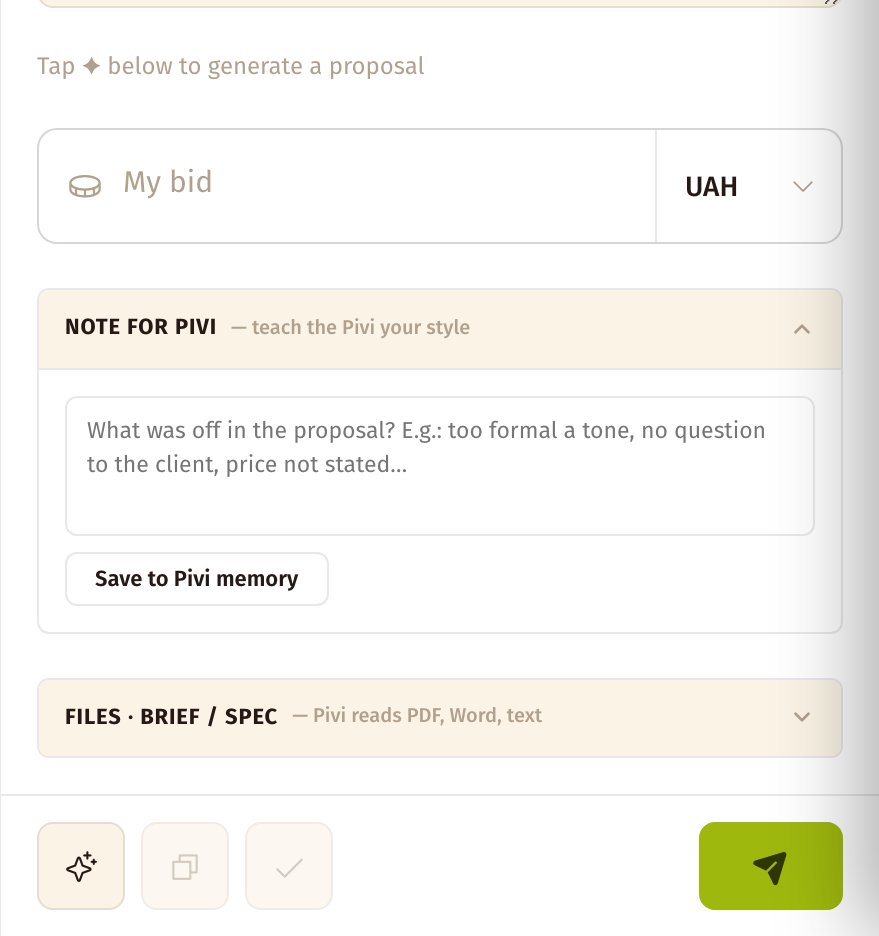
Write remarks on a draft in the “Note for Pivi” block in the same window: “no word from the brief,” “ends with an explanation about myself.” They’re saved and taken into account in later bids. What Pivi picked up from them is shown right there. You send it yourself: the button opens the project on the marketplace with the text in your clipboard.
The first 30 days need no card: pivona.io/en/about.
Where the check ends
The check is for one thing: making the client’s next message about the project. Whether it brings more replies, I haven’t measured; whether the project was worth bidding on, it won’t tell you either.
What would prove me wrong: a bid written as one paragraph, with no blocks and a question tied to a word from the brief, still gets “looks like AI.” Then the problem isn’t the structure.
The first client, the one who said my bid looked like ChatGPT, wrote again the next day: links to two projects, what was broken in each, and three direct questions. My reply with a breakdown of their setup didn’t get the label again, though whether the breakdown was the reason, I don’t know. Two days later they turned me down over the price.