
Morgan Housel’s Same as Ever works for freelancers, but three of the book’s key ideas need a different reading than they get for someone in employment.
Housel describes patterns that don’t change: people react to fear the same way, risk is born in calm, the best story wins. Three of these hold differently for a freelancer — not because the author is wrong, but because the mechanics change when your income is uneven and you’re working alone.
This isn’t a review or a summary. It’s three places in the book where I read and thought: yes, but for me it works like this.
1. The best story wins — but a story isn’t a case study
Housel’s point: it doesn’t matter how good the product is — the person who tells the better story wins.
Most people read this as “you need a case study.” Show the numbers, the result, the chart.
I had a moment when I didn’t have a case study. A client asked for a cold outreach portfolio. I wrote: “I can’t show you a finished campaign with a reply rate, because there isn’t one, and I’m not going to fake a case study.”
That wasn’t a refusal to tell a story. It was a different story — not about the result, but about character.
The client kept talking, and we started working together.
Here’s what I took from it. There might be no case study at all, and the story still wins — if it’s about how a person handles the unknown.
And the key thing is tone. The exact same honesty, said with hesitation, reads as an excuse. Said with confidence, it reads as accountability.
The difference isn’t in the facts. It’s in who you are in that story.
2. Risk is born in calm — and willpower won’t help here
Housel describes this at scale: after a long peace, nobody prepares for a crisis, and that’s exactly why it arrives.
For a freelancer, it looks simpler. A busy month is the most dangerous state to be in.
When there’s work, you’re not looking for new clients. You’re not counting what’s left after tax. You’re not checking who’s gone quiet. Everything’s fine — and that’s exactly why you do nothing.
After three years of growth, I had a year when income dropped by 33%. Not because anything broke. Because the year before, everything had run itself, and I stopped preparing.
Housel describes the problem. But he doesn’t give you a mechanism.
For a freelancer, there is a mechanism, and it’s not about willpower: when finding clients, tracking money and deadlines live in a system instead of in your memory, a “calm, busy month” stops being a blind spot.
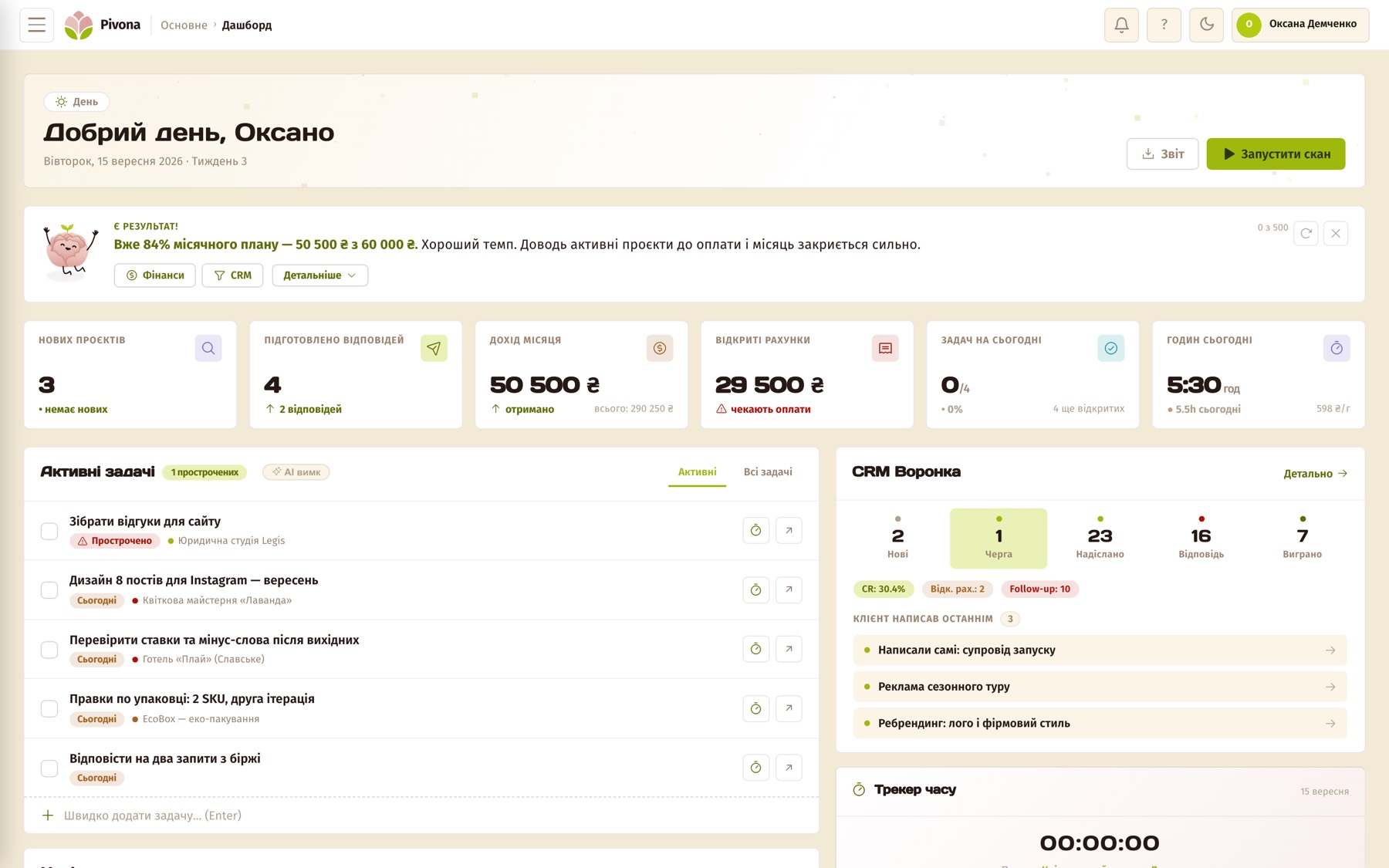
You don’t need to remember to prepare — the system does it for you. I built Pivona precisely because remembering in time never worked for me.
What I took from this as a minimum action: open the dashboard on the 1st of every month and look at three numbers — how many new leads, how many unanswered, how much is left after expenses. If all three are fine, good. If not, you find out now, not in two months.
3. Your brain brakes on opportunity — you can work around it by changing the process
Housel’s point: when your brain sees a threat in an opportunity, it puts the brakes on. That’s biology, not weakness.
Raising your price is a textbook threat. You know your rate is too low. You’ve known it for months. And you do nothing, because your brain sees the risk: the client might leave.
Talking yourself into it doesn’t work. What does work is changing the process by which information reaches the decision.
I broke the work down into hours — infrastructure, segmentation, the database, running it, reporting. I looked at the total, and realised my original figure had been too low.
“I want more money” is a conflict. “Here’s what the total is made of” is arithmetic.
Five specific phrases for that conversation are in the article about raising your price.
What stays with me from this
Housel writes about patterns that don’t change. These three observations are about what to do with them if you work alone.
- No case study — tell them how you handle the unknown. In a tone of confidence, not apology.
- Calm is the most dangerous state. Check three numbers on the 1st of every month: new leads, unanswered, balance after expenses.
- Fear doesn’t go away from talking yourself into it — it goes away when you change the process. Recalculate, and the decision stops being frightening.
Morgan Housel, “Same as Ever: A Guide to What Never Changes” (Ukrainian edition: “Nezminne”). ISBN: 978-0-593-33233-9.