Raising your price without losing the client means breaking the work down into hours and showing exactly where the new figure comes from. Below are four phrasings from my own conversations on Freelancehunt.
I’m Anastasiia Kyslenko, a freelancer since 2019, currently building Pivona. Everything below is from real conversations with real clients.
How much you lose by leaving your rate as it is
The formula: (market rate − your rate) × hours per week × 48 working weeks.
If the gap is 20%, and you work 30 hours a week, over a year you’re giving away the equivalent of nearly three months of work. Run it with your own numbers.
Which phrasing to choose
Underestimated the project → #1. Client asks to add scope → #2. Starting a new project → #3. Want to build your position first → #4.
Phrasing 1. The hour-by-hour breakdown
The strongest of the four. I used it when I realised my original estimate for the project had been too low.
Instead of “I need more” — a breakdown:
“I broke your brief down into hours, and my original figure turned out to be too low. I’m showing you the breakdown so you can see where the new number comes from. Infrastructure and warm-up — 8 hours. ICP and segmentation — 5. Database — 10. Sequences per segment — 8. Running four weeks — 12. Qualification — 6. Weekly reporting — 5. SOP — 4.”
58 hours. It’s harder to argue with arithmetic than with a total.
The client agreed.
Why it works: no apologies, no “sorry, I’ll have to raise it”. There’s an admission of my own error in the estimate — and a breakdown you can check.
Phrasing 2. A scope boundary with a price for extending it
The client says “can you add this as well”. Instead of “that’s not included” — name the price:
“[Amount 60,000–100,000 UAH] covers the Ukrainian market only. The EU, if you decide to add it, is a separate stage at roughly a third of that amount, with a second language and the GDPR piece.”
“That’s not included” sounds like a refusal. “That costs this much” sounds like a plan.
Phrasing 3. “The project price isn’t a rate for the future”
Said once, before the project starts. It removes a conflict that hasn’t happened yet:
“And for the record: this amount is the price for this project, not the rate for continuing it. If you want to carry on after we finish, we’ll work that out separately.”
The client remembers the first amount as a permanent rate — it’s the most common conflict there is. One sentence before work starts removes it completely.
Phrasing 4. Save the client money — then talk about your own
This isn’t a direct price increase. It’s what makes an increase possible.
“That’s priced per seat. A second user is another $50–70 a month, so don’t add me separately: keep the account under your name and just give me the login. Get Basic, you don’t need Professional.”
Or:
“It’s billed for a full year upfront, and our horizon is six weeks. That means we’d be paying for twelve months and using two.”
A freelancer who saves the client money on software has earned the right to say “my rate has gone up.” And they’ll be heard.
What all four have in common
Each one starts from something the client can see: an hour breakdown, the scope of work, the cost of software, the boundary of the project. The price doesn’t rise because you “decided so” — it rises because the arithmetic changed.
When you show the breakdown and name the boundaries every time, a price rise becomes a logical continuation, not a surprise.
Where I get the numbers for the hour breakdown
I’m the one building Pivona, so what follows is my own product. The screenshot only proves that this figure exists on the card. Whether it makes the conversation with a client any easier is something it can’t show — that’s the job of the phrasings above.
Hours per client per month. For clients on a monthly rate, the card has a “Rhythm margin” block: how much the client pays per month, how many hours actually went into them according to the timer and tasks, and what that works out to per hour. I build the breakdown for phrasing 1 from these hours, instead of counting from zero every time.
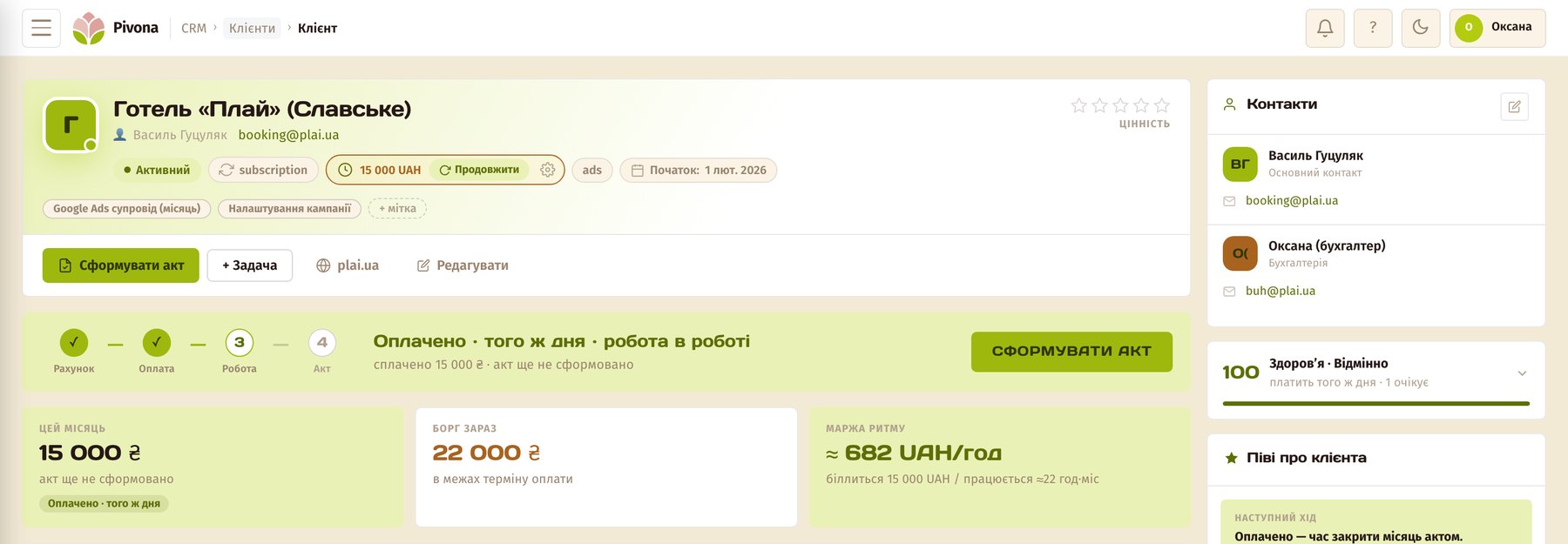
Who to raise first, and whether it worked. The same figure on every card shows which of my clients I’m earning the least per hour from, and that’s where I start the conversation. Afterwards, the same number tells me whether the new price actually covered the hours.
If you’ve already raised your price, you don’t need this section. For anyone who still has to work it out from scratch every time: the first 30 days are free, no card required, at pivona.io/pro-pivona. After that it’s ₴1,290 a month, or a free mode for three clients.