
To evaluate how profitable a client actually is, a freelancer calculates UAH/hour = (payments received over the period − direct costs) ÷ actual hours worked, including revisions, calls and correspondence.
The formula is simple. The problem is in the denominator.
Two clients from my own base: an 18x difference in average payment
I pulled this data from a spreadsheet, before I started building Pivona. Here are two clients who sit next to each other in the rows but live in completely different realities.
Client A. 14 payments over eight months. We’ve worked together since late 2025.
Client B. 153 payments over six years. We’ve worked together since 2020.
Client A’s average payment is 18 times larger. And in total, over all that time, Client B brought in less than Client A did in eight months.
Client B looks like the most loyal one: six years, 153 payments, not a single gap. Client A is recent, large, unstable.
Now let’s count attention.
153 payments means 153 times issuing an invoice, checking whether it’s been paid, replying to a message. Even if each exchange takes only 20 minutes — a minimum that’s hard to imagine being lower — that’s already 51 hours of administration alone, and all of it for a smaller sum than Client A brought in.
14 payments means 14 cycles. For a larger sum, over eight months.
The one who looks most loyal may be eating up the most attention for every hryvnia earned — but without hours, that’s just a hypothesis.
Without hours, the formula doesn’t work
I don’t have hours logged per client.
I’ve been tracking time since March 2026, and not for every task. So I can’t calculate an honest UAH/hour for Client A and Client B. All I can see is the contrast in payment size — and that contrast is 18x.
And that’s the first thing the formula shows: without a denominator, you don’t know who feeds you. You know who pays. Who pays the most. Who’s been around the longest. But not who gives you the most money per hour of your time.
How to calculate it — if you have a timer
Step 1. Sum of payments from the client over the last 3 months.
Step 2. Subtract direct costs: software you buy for this client, subcontractors, ads paid out of your own pocket.
Step 3. Count actual hours. Not just “sat down and worked” — revisions, calls, correspondence, waiting for feedback, that “quick 10-minute call” that turned into 40.
Step 4. Divide.
Compare the resulting number to your target rate. Rule of thumb: target rate × 1.3 (because part of your time is unpaid admin). If the UAH/hour for a client comes in below that line, you’re subsidising that client with your own time.
When it’s worth calculating — and when it isn’t
If you have 2-3 clients and can see every payment on one screen, you already know the answer.
It’s worth calculating when: – you have 4+ clients – there’s one “big” client you’re afraid to lose – you feel like you’re working a lot but not earning much, and you can’t tell where exactly it’s going
What to do with the answer
The worst thing you can do is keep quietly working with a client who costs you more than they bring in.
The best thing is to calculate it and talk.
When I raised the price for one client, I didn’t say “it got more expensive.” I broke the scope down by hours and showed exactly where the new number came from.
The client isn’t arguing with you — they’re arguing with the arithmetic, and they can see it’s on their side.
The formula isn’t “it got more expensive.” The formula is “here’s what it’s made of.”
How exactly to break down a scope of work and what to say — in the next article.
The first step
Open your bank statement or your CRM. Look at how many payments came from each client over the last 3 months. Just the count and the sum. No hours, no costs — just who, how much, how often.
This takes 10 minutes. And you’ll already see the contrast.
Then turn on a timer for one week. For every task, every call, every “quick little fix.” A week later you’ll have a denominator — and the formula will finally work.
Where I keep this denominator
You still turn the timer on yourself, but after that the number is calculated without a spreadsheet, and that’s exactly what I’m showing here, because I’m building Pivona. A screenshot only proves that a number like this exists on screen — it doesn’t know whether it’ll match yours.
Hourly rate for each client. In the “Analytics · Clients” section, under each client it shows how many hours have been paid for and what the resulting hourly rate is. The formula is slightly different from the one in this article: Pivona divides what’s been paid by logged hours, and you still have to subtract direct costs from that number yourself, separately.
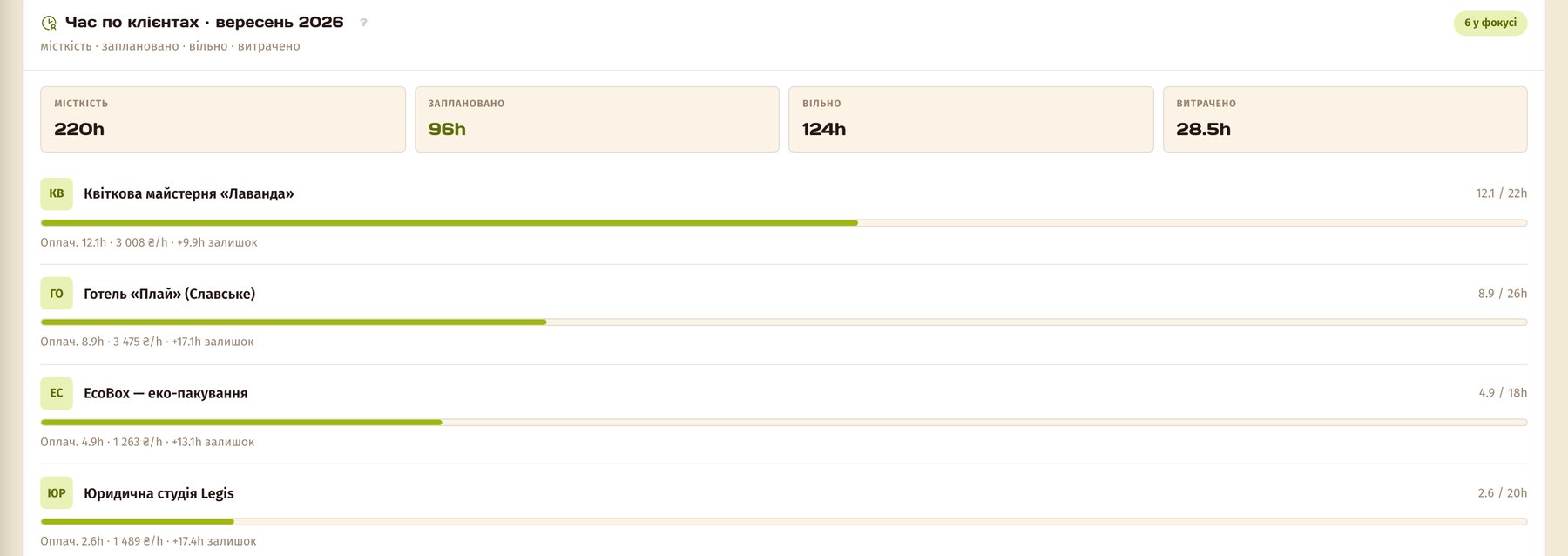
The tool doesn’t reconstruct the past. The denominator starts on the day you turn the timer on, so I’ll never be able to calculate a rate for Client B from this article. But hours no longer need to be pulled into a separate spreadsheet once a quarter, the way they were for this article.
If you have two or three clients and the answer is already obvious, you can skip this section. For four or more, there’s a simple test: one week with the timer, and a rate for each of them on screen. The first 30 days are free, no card required: pivona.io/pro-pivona. After that it’s 1,290 UAH a month, or a free tier that keeps three active clients.