In my experience, chaos in your work — when tasks, payments and deadlines live in different places — creates a background anxiety that, over time, wears you down more than the work itself.
Not a diagnosis. An observation about myself over the course of a year, backed by numbers from my own records.
What I call chaos
Not being swamped with orders. Not a deadline due tomorrow.
Chaos is when:
- the agreement with a client is in Telegram, the invoice is in email, the task is in your head
- you don’t know how much you’ve earned this month, because payments land on different cards at different times
- a lead wrote “send me the details” — and you see it four days later
- a client asks for a status update, and you can’t remember where you left off
- it’s Friday evening, and you’re working out whether you’ll have enough for your ЄСВ payment
Each of these on its own is nothing. Together, they’re a background you never get a break from.
What I changed — three specific things
Burnout is complicated. Structure doesn’t cure it completely.
Isolation, a toxic client, work you hate — that’s a different problem. A spreadsheet won’t fix that.
But the part that comes from chaos — that part you can remove.
1. I started tracking my time
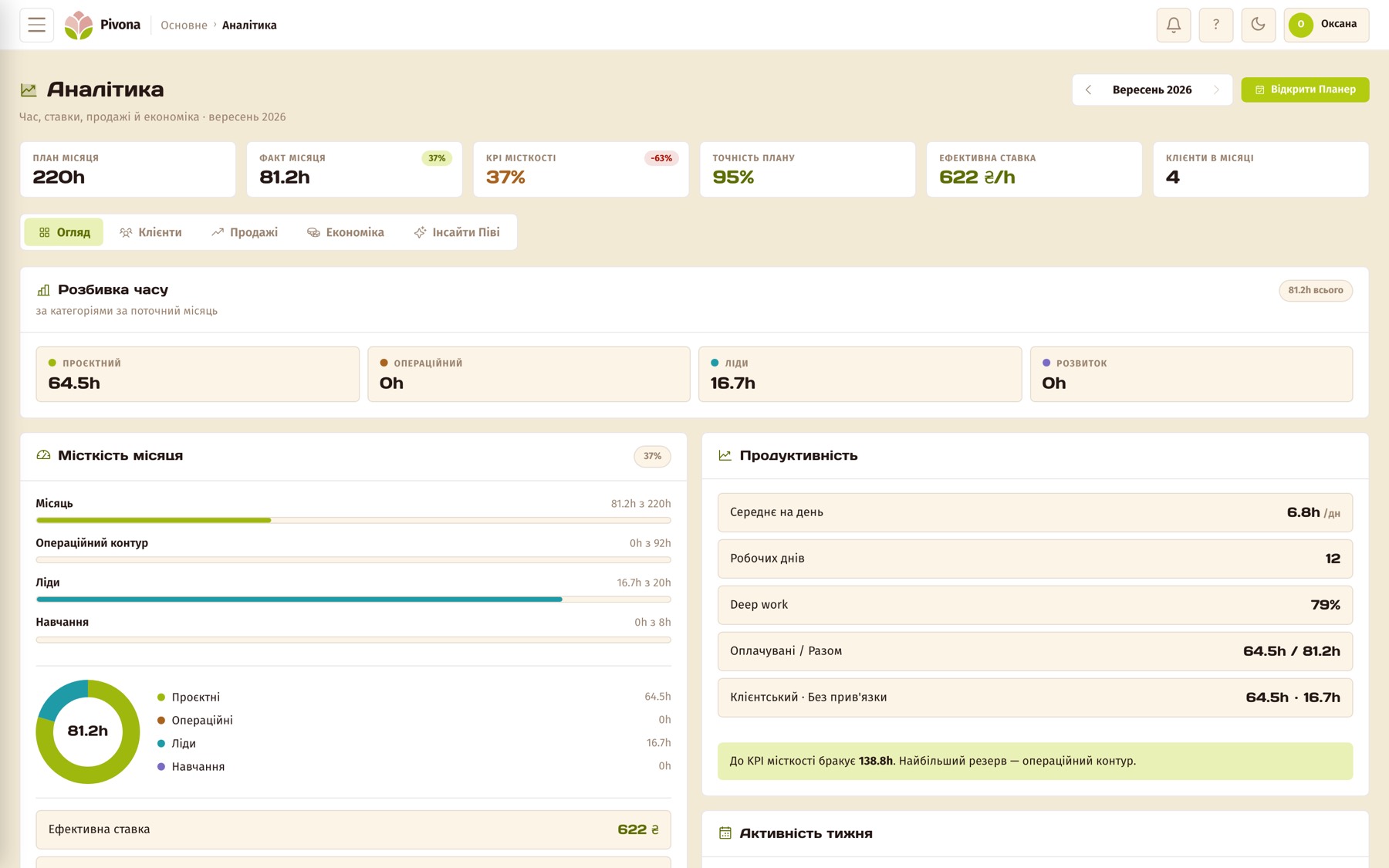
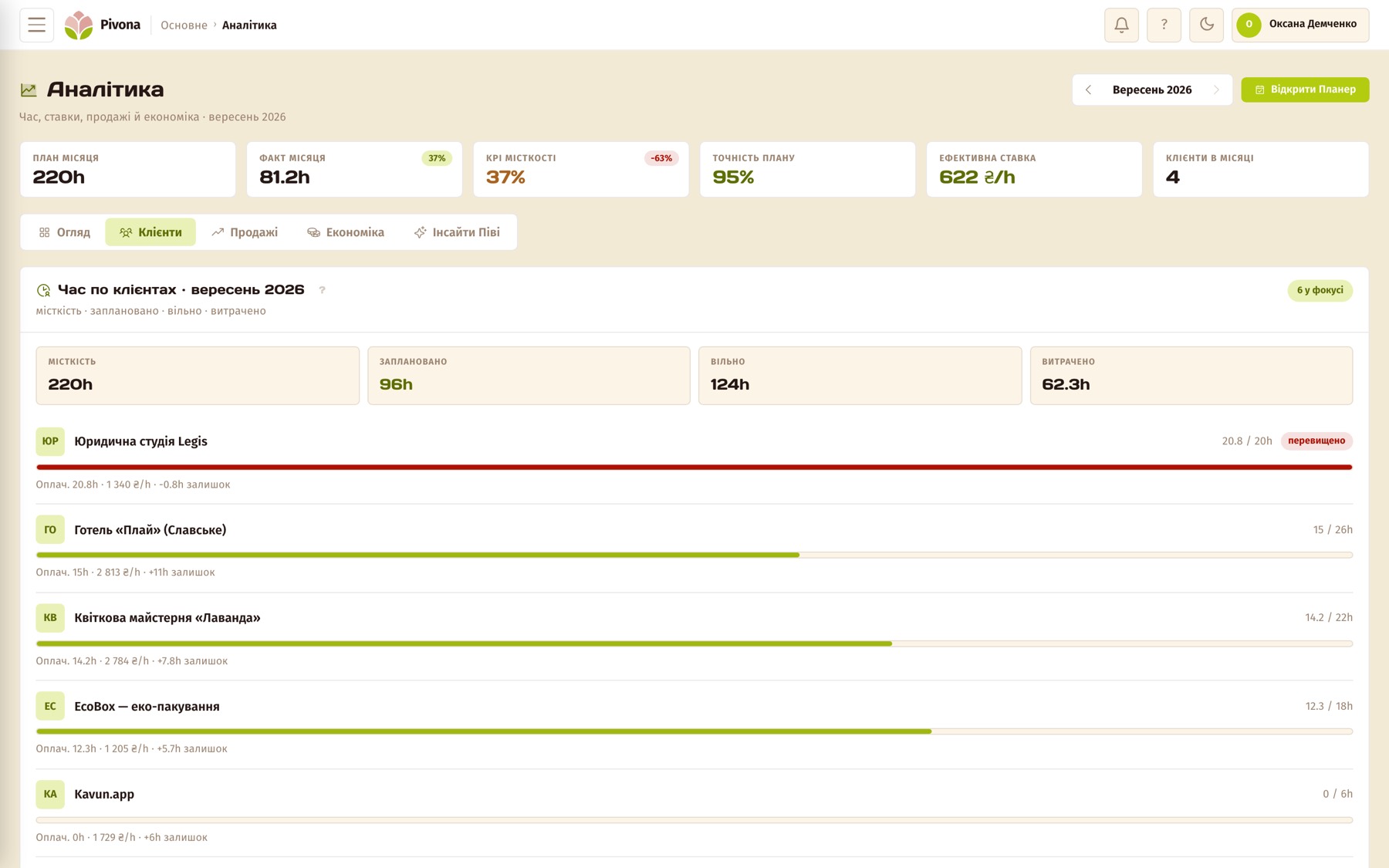
In March 2026 I started tracking my time. Not for client reporting — for myself.
Over five and a half months: 291 entries, 177.5 hours. And this is the most honest part of the story: I wasn’t tracking all of my work. I actually worked several times more than that — the tracker only started when I remembered to switch it on.
That’s exactly why I don’t calculate my rate from these hours — the denominator is incomplete, and any “per hour” figure built on it would be a pretty lie.
What it gave me even in this form: for the first time, I saw where time went outside actual work.
Looking for information. Switching between clients. Correspondence that moves nothing forward.
This isn’t “waste.” It’s a reality I couldn’t see before.
2. I looked at income by client
Not total turnover for the month. How much each client actually brings in — and for how many payments.
One client brought in 400,000+ hryvnia across 14 payments. Another brought in 240,000+ across 153 payments. The difference in average payment size is roughly 18 times.
The second one looked like my most loyal client. We’d worked together since 2020. But that was exactly the one taking up the most attention per hryvnia of income.
I’m not saying “drop a client like that.” I’m saying: until you can see this, you’re making decisions blind.
3. I started writing agreements before starting work
Not a contract. One message before a project starts: scope, payment, timeline, software, and a note that this price is for this project, not a rate for the future.
Three situations that used to turn into conflicts now get resolved before they escalate — there’s an agreement on record:
- a client adds tasks outside the scope → there’s something to point to
- “but we agreed on a different amount” → no, here’s the message
- a “10-minute call” turns into 40 → there’s a set boundary
The conflict doesn’t disappear. But now it starts from a fact, not from “I think we agreed.”
What this didn’t fix
Switching between six clients didn’t get any easier just because I know how much time it takes.
Anxiety before a hard conversation about price doesn’t go away because of a spreadsheet. It goes away when you break the total down into hours, and the client ends up arguing with arithmetic instead of with you.
And most important: when you’re exhausted, you don’t open any system. Not a spreadsheet, not a CRM, not Notion. You open Telegram and answer whatever’s on fire.
Structure works when you have the energy for it. When you don’t, only one thing works: fewer clients, fewer tasks, fewer promises.
468 unanswered enquiries in six months
Over six months, 468 enquiries passed through my pipeline that I never answered at all.
It’s not that I “sometimes forget to reply.” I systematically can’t keep up with the incoming flow.
This isn’t a motivation problem. It’s a process problem.
What you can do in one evening
Not rebuild everything. One step.
- Gather last quarter’s payments into one table. By client. So you can see who brought in how much, and for how many payments.
- Or: open your messenger and count how many messages from leads went unanswered over the last month.
- Or: write to one client before the next project starts: “here’s the scope, here’s the price, here’s the timeline — does this match what you have?”
Not all three. One.
Chaos doesn’t clear up in one evening. But seeing it — that you can do.